Altruist Biologics' Hangzhou Facility Secures First Commercial Manufacturing License
- First GMP manufacturing license granted to a manufacturing facility in China with four 20,000 liter-scale bioreactors, marking an important milestone in Altruist's expanding service capabilities.
- Only two months from facility qualification to licensure, demonstrating the company's commitment to outstanding technical capabilities and a rigorous quality management system that upholds international standards.
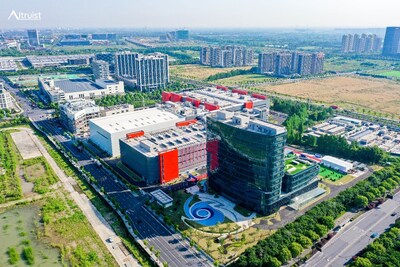
HANGZHOU, China, April 8, 2026 /PRNewswire/ -- Altruist Biologics, an Innovent Biologics subsidiary and world-class contract development and manufacturing organization (CDMO), announced that its Hangzhou facility was granted the Drug Product Manufacturing License (C Certificate) from the Chinese National Medical Products Administration (NMPA). This is the first certificate awarded to a 20,000-liter scale biologics manufacturing facility in China, confirming that its quality systems, GMP facilities, and technologies meet the rigorous requirements of regulatory health authorities for drug production quality management.
Dr. Kaisong Zhou, Chairman and CEO of Altruist Biologics, commented, "We're pleased that our Hangzhou facility successfully achieved the C Certificate for biologics commercial manufacturing. This represents another remarkable milestone in our efforts to establish premier-quality operations and fully integrated services to support our clients' commercialization goals. We look forward to supporting the development and manufacture of more life-saving treatments for our global clients to benefit patients worldwide."
As one of China's leading CDMOs in commercial-scale manufacturing, Altruist has consistently demonstrated a proven track record of adherence to the industry's most rigorous quality standards. To date, the company has supported the successful commercialization of eight products, with several achieving regulatory submissions across the United States, Europe, and China. It has also successfully passed 30 regulatory inspections, including one conducted by the FDA and EMA, as well as more than 13 GMP quality audits conducted by global clients.
The Hangzhou facility commenced partial operations in 2024 with the commissioning of four 20,000-liter stainless steel bioreactors, the first and largest of their kind in China. The site will hold a total capacity of 172,000 liters upon completion. It also offers a standalone ADC and AXC bioconjugation facility to support the manufacture of various bioconjugates, including high potency ADCs for clinical and commercial supply in both small- and large-scale production.
Building on its accumulated expertise and advanced technologies, Altruist Biologics will continuously strengthen its capabilities and quality systems to align with anticipated market needs, providing flexible, cost-effective services that help clients overcome manufacturing barriers and accelerate their life-saving therapies to patients.
For more information about Altruist Biologics' end-to-end service capabilities, please visit: www.altruistbio.com.
About Altruist Biologics
Altruist Biologics is a reliable CDMO service provider and wholly owned subsidiary of Innovent Biologics, focusing on the development, clinical, and commercial manufacturing of antibodies, fusion proteins, antibody drug conjugates, and other drugs. From cell line development to aseptic fill-finish, we are committed to supporting our clients in developing affordable and high-quality biopharmaceuticals for the benefit of patients worldwide. With our state-of-the-art, CGMP-compliant facilities and operations based in China, Altruist Biologics offers a 60,000-liter total capacity at its Suzhou site, which meets global regulatory standards from the NMPA, FDA, EMA, and PMDA, and commenced partial operations at our Hangzhou site with the completion of four 20,000-liter bioreactors, the first and largest of its kind in China. The Hangzhou site will hold a total capacity of 172,000 liters upon completion. Guided by our mission to provide a path forward for every molecule, we continuously strengthen our capabilities and quality systems to align with anticipated market and client needs to provide the most efficient and cost-effective services.
Media Contact:
Courtney Garcia
Director of Global Marketing & Communications
courtney.garcia@altruistbio.com
Photo - https://mma.prnewswire.com/media/2950325/image.jpg
Logo - https://mma.prnewswire.com/media/2924360/5901729/Altruist_Biologics_Logo.jpg
 View original content:https://www.prnewswire.co.uk/news-releases/altruist-biologics-hangzhou-facility-secures-first-commercial-manufacturing-license-302734786.html


