Arctech Strengthens Central Asia Presence with 425 MW of New Solar Projects
KUNSHAN, China, Aug. 11, 2026 /PRNewswire/ -- Arctech, a global leader in solar tracking and mounting solutions, has secured 425 MW of new utility-scale projects across Central Asia, including a 325 MW SkyLine II project in Kyrgyzstan and a 100 MW SkyLine II project in Kazakhstan. These new projects further strengthen Arctech's presence in the region and build on its track record in one of the world's fastest-growing renewable energy markets.
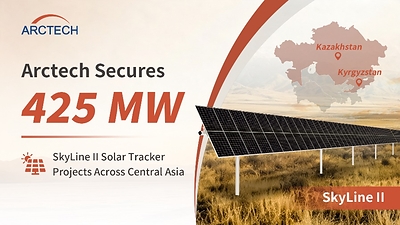
From frost-heave soils and gravel areas to challenging terrain and varying geological conditions, the region presents demanding requirements for solar project design and execution.
In Kyrgyzstan, the 325 MW project faces frost-heave soils, gravel areas and complex terrain, creating challenges for both foundation design and on-site construction. Arctech developed a customized foundation solution tailored to the local ground conditions, while SkyLine II's terrain adaptability helped accommodate the complex terrain. Extensive pre-assembly and optimized construction planning further streamlined on-site installation and improved efficiency.
In Kazakhstan, the 100 MW project is situated in an environment characterized by frost-heave soils and varying geological conditions. Arctech applied site-specific engineering optimization and foundation verification to ensure the tracking system and foundations were well matched to the local ground conditions, while tailored delivery planning supported efficient project execution.
Together, these projects demonstrate Arctech's ability to combine terrain-adaptive tracking technology with site-specific engineering solutions, enabling reliable solar deployment across diverse and challenging environments.
The latest awards add to Arctech's growing track record in Central Asia. To date, the company has delivered more than 3.5 GW of solar tracking and mounting systems across the region, including more than 700 MW in Kyrgyzstan and more than 900 MW in Kazakhstan. Backed by its Eurasia team, deep localized engineering expertise and long-standing partnerships, Arctech continues to build strong capabilities to serve the region's evolving solar market.
As Central Asia accelerates its renewable energy transition, demand for reliable and adaptable utility-scale solar solutions is expected to continue growing. Moving forward, Arctech remains committed to deepening its regional expertise and collaborating closely with customers and partners to support the region's long-term clean energy goals.
About Arctech
Arctech is a leading provider of solar tracking systems, smart mounting solutions, and integrated energy solutions. For more information about Arctech, visit: https://en.arctechsolar.com/
 View original content to download multimedia:https://www.prnewswire.co.uk/news-releases/arctech-strengthens-central-asia-presence-with-425-mw-of-new-solar-projects-302848310.html