LONGi Showcases LONGi ONE at SNEC 2026, Advancing Native Solar-Plus-Storage Integration
SHANGHAI, June 4, 2026 /PRNewswire/ -- At SNEC 2026, LONGi further advanced its LONGi ONE solar-plus-storage strategy, demonstrating how a unified technology architecture can address long-standing challenges and improve project economics across solar and energy storage deployments.
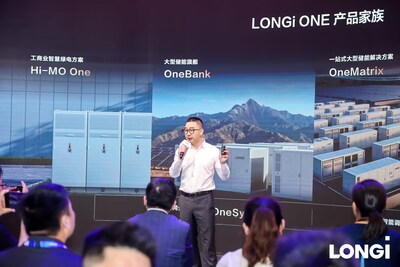
As solar-plus-storage becomes a mainstream pathway for energy transition, many projects still rely on equipment from multiple suppliers, resulting in additional system losses, complex commissioning, and unclear responsibility boundaries. Built on the LONGi ONE strategy, LONGi is promoting an integrated approach through native system design, measurable performance gains, and lifecycle accountability.
From Fragmented Systems to Native Integration
At SNEC 2026, the company showcased a complete portfolio spanning utility-scale and commercial & industrial (C&I) applications, including OneBank 2.0, OneMatrix 2.0, Hi-MO One, OneOS, as well as the newly introduced OneNexus microgrid solution and OneSync PCS. Built on a unified technology stack, the portfolio enables coordinated operation across generation, storage, conversion and control, reducing system complexity while improving overall performance.
Measurable System-Level Value
According to internal testing, OneBank 2.0 and OneMatrix 2.0 achieve a round-trip efficiency (RTE) of 93%, approximately four percentage points higher than typical standalone architectures. Cluster-level management further improves battery utilization and increases lifetime energy output by up to 8%.
Combined, higher RTE and energy output can increase project returns by 2-4%, particularly in high-cycle applications. The integrated architecture also supports a system availability of 99%, improving operational reliability throughout the asset lifecycle.
For C&I applications, Hi-MO One integrates with the OneOS platform and supports flexible duration configurations ranging from 2 to 24 hours through a 1+N modular architecture. In a recently commissioned C&I project in China, the integrated solar-plus-storage system increased on-site solar utilization from below 60% to more than 90%, while supporting peak shaving, demand charge management, and future readiness for virtual power plant (VPP) participation.
Lifecycle Accountability and Global Service
Beyond system performance, LONGi emphasized a single point of accountability across the project lifecycle, helping simplify project execution and reduce multi-vendor coordination.
To strengthen localized support, LONGi is advancing its "2830 Plan", establishing 30 dedicated solar-plus-storage service centers across key global markets to provide local expertise and responsive support throughout the asset lifecycle.
At SNEC 2026, LONGi demonstrated how LONGi ONE is being translated into deployable products, measurable system value, lifecycle accountability and localized service capabilities through its "One System, One Platform and One Responsibility" architecture.
Photo - https://mma.prnewswire.com/media/2994714/5c1d7e60_cd2c_4a59_a3cc_1a2aca50ed99.jpg
Logo - https://mma.prnewswire.com/media/2948064/5896117/LONGi_Red_Trans_Logo.jpg
 View original content:https://www.prnewswire.co.uk/news-releases/longi-showcases-longi-one-at-snec-2026-advancing-native-solar-plus-storage-integration-302790958.html