Temu helps European small businesses expand internationally and create new jobs, survey shows
Temu survey finds half of responding sellers increased capacity, hired staff or both, while one in three surveyed across EU markets expanded internationally
DUBLIN, Aug. 31, 2026 /PRNewswire/ -- European businesses selling on Temu report hiring staff, increasing capacity and reaching customers in new international markets, according to a survey by the e-commerce platform.
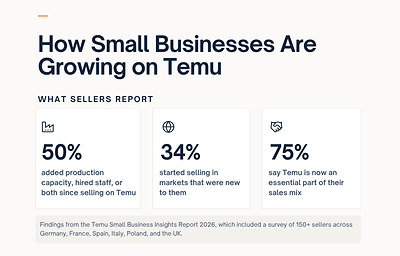
Half (50%) of the more than 150 respondents said they had increased capacity, hired additional staff or both since joining Temu. One in three (34%) respondents surveyed reported expanding into new international markets.
Other key findings include:
- Three quarters (75%) described Temu as either an important additional sales channel or their primary sales channel.
- More than four in ten (43%) respondents had already been trading for over a decade before joining the platform, suggesting Temu was helping established businesses to grow their operations.
"The survey findings underscore the immense potential of Europe's small businesses and aspiring entrepreneurs to grow if there were simpler, more affordable ways to reach new customers," said a spokesperson for Temu. "We look forward to continuing our work in helping sellers grow at home and abroad and create jobs within their communities."
Temu surveyed more than 150 sellers on its platform across Germany, France, Spain, Italy, Poland and the UK in June and July 2026. The findings are part of the Temu Small Business Insights Report 2026, which sets out the company's engagement with industry organisations across Europe — including more than 100 stakeholder meetings — and its approach to helping small firms grow online.
Temu has welcomed local businesses in Europe to sell on its platform since 2024. Today, the Temu Local Seller Programme is open to businesses of all sizes in more than 35 markets, including much of Europe.
Creating jobs and expanding capacity
"Temu has impacted the business very positively, without a doubt. It has meant significant growth for Recamania," said Natalia Collado Castillo, 26, who joined the family-owned spare-parts business in Albacete, Spain, as it expanded following its launch on Temu.
Recamania had been trading for more than 40 years but had previously struggled to establish a successful online sales channel. The company opened its Temu store in March 2025 and worked closely with Temu's business development team to improve its listings and approach. Soon, it had received 4,000 orders per month through the platform, which led to the business growing its warehouse and administrative teams to keep up with the increased workload.
In the UK, Leeds-based retailer Money Cruncher, which also trades online as Spot On-Line, has fulfilled more than a million orders since joining Temu at the beginning of 2025. The business added more than 20 warehouse roles in the last 18 months to cope with the extra demand from its Temu sales channel.
In France, Mathis Rouchouze and Charles Jeuffrain launched their ube powder brand, Ubedia, on Temu in September 2025. Within weeks, the Aix-en-Provence business had sold more than 1,400 packets of ube powder through organic traffic on the platform.
The early sales enabled both founders to leave their day jobs and work on Ubedia full time. The company now employs six people across production, shipping and marketing, is investing in automated packing equipment and plans to recruit further as it expands into other European markets.
"Temu gave us instant visibility," said co-founder Mathis Rouchouze. "Good reviews brought more exposure, which led to more sales."
Temu's approach to supporting local sellers is informed by meetings and discussions with industry bodies, trade associations and other stakeholders. Across these conversations, three recurring challenges emerged: complexity, cost and connection.
Temu is addressing each of these barriers directly, with dedicated onboarding support, streamlined fulfillment tools, and growing partnerships with local trade bodies and startup networks.
The survey found that 38% of respondents valued Temu's easy-to-use seller platform, while 35% cited its fair cost structure. Connection stood out particularly strongly, with more than 65% valuing the personal, dedicated support available to sellers.
Reaching customers in new markets
"Joining Temu changed everything," said Antonino Quaranta, owner of SD Calabria, a family-run Italian specialty food business. "Now I see Spanish customer names, German surnames, buyers from the Netherlands, Poland, Austria, Ireland, Denmark, and the Czech Republic. Before, I only saw Italian names. Now it's a completely different picture."
Before joining Temu, SD Calabria's customers outside Italy were predominantly Italian expatriates. Selling on the platform has allowed the business to reach a much broader customer base across Europe without investing in separate marketing campaigns in each country. Quaranta said Temu's organic traffic had been particularly valuable for a small business with limited resources for international promotion.
The survey found particularly strong international expansion, with one in three (34%) sellers surveyed expanding into new international markets. Within weeks of joining Temu, Polish electronics distributor Euroelectronics had expanded into 18 European markets, including countries in which it had not previously operated. Rather than developing and managing a separate launch strategy for each country, Euroelectronics was able to make its extensive product catalogue available across several markets simultaneously, supported by its existing warehousing operation.
Connecting sellers with practical support
Having launched in Europe in April 2023, the platform now operates in more than 90 markets, including all EU Member States, offering products across more than 700 categories.
For German manufacturer AMF Creation, Temu offered a simpler way to adapt to a rapidly changing e-commerce market. The 15-year-old business said the platform's straightforward onboarding, real-time insights and dedicated seller support helped it refine its online strategy, reach new customers and respond more quickly to demand.
"Instead of guessing what customers want, we now have data to guide our decisions," said founder Marcus Fochler. "If something wasn't working, we could pivot immediately. That kind of flexibility was exactly what we needed."
Notes
- 152 local sellers across Germany, France, Spain, Italy, Poland and the UK responded to Temu's European Seller Survey in June and July 2026.
- 50% of respondents reported increasing production or operational capacity, hiring additional staff, or both since joining Temu.
- 34% of respondents operating in EU markets reported expanding into new international markets after joining Temu.
- 75% of respondents described Temu as either an important additional sales channel or their primary sales channel.
- 43% of respondents had been trading for over a decade before joining Temu.
- 38% of respondents identified Temu's easy-to-use seller platform as a reason for choosing the marketplace.
- 35% of respondents identified Temu's cost structure as a reason for choosing the marketplace.
- 65% of respondents said they valued the personal or dedicated support available to sellers.
 View original content to download multimedia:https://www.prnewswire.co.uk/news-releases/temu-helps-european-small-businesses-expand-internationally-and-create-new-jobs-survey-shows-302864745.html